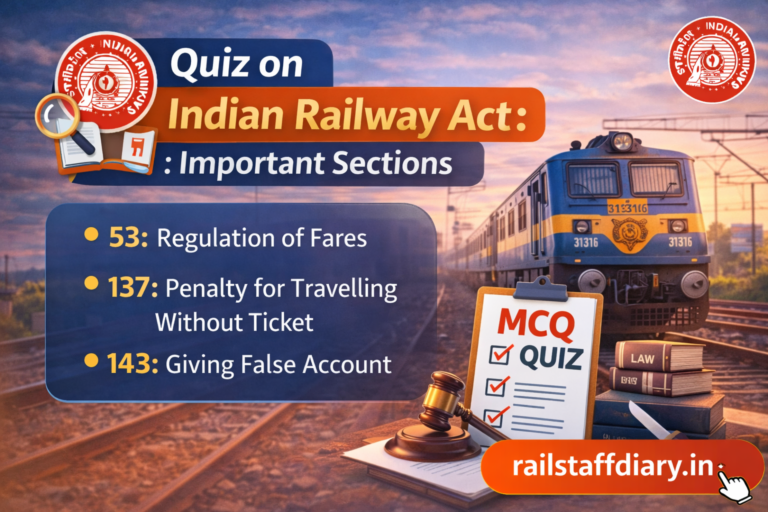
25 Most Improtant MCQs on Indian Railway Act : If you are preparing for the LDCE 30% Limited Departmental Competitive Examination, mastering the Railways Act is a non-negotiable part of your syllabus. Quiz on Indian Railway Act. The Commercial Department’s efficiency and legal standing rest on these specific sections, which define everything from passenger rights to the penalties for ticketless travel.
This test is designed to sharpen your understanding of critical legal distinctions, such as the difference between Section 137 (fraudulent intent) and Section 138 (excess fare/charge). Use these questions to validate your knowledge of statutory obligations—like the exhibition of fare tables —and the specific powers granted to authorized railway servants in cases of nuisance or obstruction .
Challenge yourself with this mock quiz to ensure you are fully prepared to handle the commercial and legal complexities of the Indian Railways .
Success in the LDCE 30% examination requires more than just memorizing numbers; it requires a deep functional understanding of the legal powers and duties that define the Commercial Department . From knowing the specific protections for unaccompanied women under Section 139 to the strict penalties for touting under Section 143, these rules are the foundation of a fair and efficient railway system . By mastering these sections, you aren’t just preparing for an exam—you are equipping yourself to be a more effective, informed, and confident Railway Officer.
Commercial Mock Tests
- Indian Railway Ticket Checking Mock Test 1 – MCQ
- 25 Essential MCQs on Railway Ticket Checking Rules & Procedures (2026 Edition)
- Quiz on Gati Shakti Multi-Modal Cargo Terminal (GCT)
- Passengers and Passenger Tickets
- Indian Railway Parcel Mock Test 1 – MCQ
- Indian Railway Parcel Mock Test 2 – MCQ
- MCQ Quiz on Railway Goods Loading , Delivery
- Railway Goods Theory Mock Test
- Station to Station (STS) Rates Scheme
- Online Booking of FTR Trains and Coaches including MCQ
- Goods Theory Quiz: Demurrage, Wharfage & Siding Rules for LDCE 30% Exam Prep
Commercial Mini Mock Test
- Mini Mock Test 1
- Booking office – Commercial Mini Mock Test – 2
- Mini Mock Test on Railway Goods and Parcel Booking
Check other Quizzes Related to Rajbhasa
- Rajbhasha Quiz – Top 15 Questions : ACM AOM AEN APO LDCE EXAM
- Rajbhasha MCQ Railway – Question Answers
Also Check Establishment Mock test
- Establishment Mock Test – 1
- Establishment Mock Test – 2
- Establishment Mock Test – 3
- Railway Leave Rules – Mock Test
- Railway Pass PTO Rules – Mock Test
- Disciplinary & Appeal Rules (DAR) – Mock Test – Railway Service 1968
- Departmental Exam Prep: Railway Services (Conduct) Rules Quiz
- Staff Benefit Fund (SBF) Railway – Overview, MCQ , Quiz